Archive for the “Holidays” Category

Shabbat Shalom and welcome to Judeo Talk. The Torah portion for this week is parsha Bo, Exodus 10:1-13:16.
Parsha Bo is one of the most important, pervasive segments of the Torah. The origins of some very important liturgy come from Bo, as do the first instructions for the holiday of Passover. But first, there are the concluding three of the ten plagues. They are locusts, darkness and the death of the first born.
The plagues themselves seem almost arbitrary. They are a strange mix of natural disasters that don’t seem to be related. Upon deeper reading, their connection becomes apparent. As we saw last week, these plagues are not intended as a punishment for Egypt or even to coax the pharaoh to release his slaves. Rather, they occurred as a demonstration, to make a point. Each of the ten plagues is a direct assault on one of the gods in the Egyptian pantheon through some symbol of their presence. For example, the turning of water into blood was the first plague, and rightfully so. Most of the water in Egypt would have come from the Nile river. According to Egyptian mythology, the god of the Nile was Hapi the father of the gods, and later Osiris the god of rebirth.
The last two gods assaulted by the ten plagues are Ra, the supreme god and god of the sun, and the pharaoh, seen at the time as being a god given flesh to rule over the people. The death of the first born is a plague directed at the pharaoh’s ability to maintain his line’s hegemony in Egypt.
Before the tenth and final plague, God instructs Moses to tell the Israelites to mark their doors with the blood of a sacrificial lamb as a sign to spare their houses from the death of the first born. In addition, the lamb is supposed to be made into a feast for the house. The instructions also demand that this observance should be repeated every year at the same time. In addition to the eating of a sacrificial lamb, the Israelites are told to eat only unleavened bread for the entire week of the festival. The reason for this becomes apparent later in the parsha. When the Egyptians finally tell the Israelites to leave the land, they push them out in a hurry. It all happens so fast that the Israelites don’t even have time to let the dough of their bread rise.
This parsha has one of my favorite lines in the entire Torah. God instructs the Israelites to prepare themselves to leave Egypt by saying they should eat their lamb feast, “With your loins girded, your shoes on your feet and your staff in your hand.” What an excellent line. The feast of the pascal lamb isn’t some random ritual. These people needed to eat a good meal to get up their strength for the long journey ahead. This line has so much meaning beyond the literal. As we will see, the voyage from slavery, through the wilderness and into the promised land is a great metaphor in the Jewish faith. It is an allegory for the search for enlightenment. God’s instruction for all those who seek truth is to begin that process prepared for the long haul.
The Israelites begin their march out of Egypt at the end of this parsha. The victory here, as the proverb goes, is not the end, it is just the beginning. They go with the instruction to pass this story down through the generations and to maintain these traditions. It is a subtle sign that all people, Jewish or otherwise, will face their own Egypt, their own personal slavery. Parsha Bo is a reminder that the road out of each individual’s Egypt is one that requires the utmost preparation.
No Comments »
Last night, the festival of Chanukah came to a close. In its way, Chanukah is unique among Jewish holidays. While many of the faith’s observances last for several nights, none but Chanukah have an active ritual repeated on each of the nights. For those who diligently keep the customs of Chanukah this means lighting the Menorah eight times, a powerful sensory ritual. The sight of the flames, the smell of the smoke, even the motion of guiding the Shamas to each branch can evoke memories of childhood and of other Chanukahs past. We do these rituals not just because they are customs but because physical acts require enough concentration to focus us on the prayers and the feelings associated with the holiday.
So, when we repeat the same prayers for eight successive nights, lent focus by the act of lighting the Menorah, it is natural for us to question what those prayers actually mean. We are a people who often pray in an ancient language that most of us can’t speak. We frequently don’t even know the literal translations, let alone the layers of meaning underneath.
On Chanukah we say two prayers every time we light the Menorah and a third prayer on the first night only. On the first night, in addition to the two others, we say the Shehechianu, a prayer said at all occasions of firsts or of new things. The other two prayers are:
 Blessed are you, Adonai our God, King of the Universe Blessed are you, Adonai our God, King of the Universe
 Who makes us holy with the Mitzvah we do Who makes us holy with the Mitzvah we do
 When we light the lights of Chanukah (amen) When we light the lights of Chanukah (amen)
And
Blessed are you, Adonai our God, King of the Universe
 Who did miracles for our fathers on this day at this time (amen) Who did miracles for our fathers on this day at this time (amen)
So, why are our prayers structured like this? Why do almost all Jewish prayers begin with the same line? Is there a purpose to the repetition of placing all the honor on God?
There are several layers of answers to these questions. First, the structure of Hebrew prayers is essentially standardized. It is a result of the Rabbinic Age in which we live. When Jerusalem was sacked by the Roman Empire the Temple was destroyed and the Jews were forced to scatter across the world. In order for the Jewish faith to survive and Jews to stay connected to one another regardless of where they lived, the prayers of our ancient heritage were standardized.
As for why the majority of Hebrew prayers open with the same line, it is part of one of the faith’s central tenets. In the Torah and in all liturgy afterward, Judaism has attempted to avoid placing too much honor or power on individual people. The responsibility and the glory almost always goes either to God or to the entire community as a whole. When we light the Chanukah candles, we do not honor Judah Maccabee or any other individual because the holiday isn’t supposed to be a time of ancestor worship. By placing the honor on God we allow hope and power to exist in the present day and out of the hands of anyone who could possibly be corrupted by such power.
We also place so much focus on community not just to keep others from becoming arrogant, but also to keep us focused on what really matters. These holidays are nothing if we don’t share them with others because these holidays don’t exist in a vacuum, cut off from the rest of our lives. However ornate or archaic the wording, these two prayers above say simple things. They can be easily translated into more concise language. “It is a good and happy thing to light Chanukah candles” and “A wonderful thing happened a long time ago. We’re so happy we can celebrate it together today.”
In order to make an ancient religion relevant to our modern lives, we must come to a colloquial understanding of what our prayers mean. By keeping the text of those prayers the same across the ages, we allow each generation to come to its own understanding of their meaning. It is a Mitzvah, a good and holy thing, to contemplate prayers and what they mean. If it sounds old, stuffy or irrelevant, chances are you just aren’t modernizing your interpretation.
No Comments »
Shalom, everyone and Chag Chanukah Sameyach! Welcome to Wednesday Hebrew at Judeo Talk. Today’s lesson is going to revolve around terms and phrases relating to the holiday of Chanukah. Tonight is the fourth night of the Festival of Lights. Word has it there’s this other holiday happening sometime soon, though I can’t seem to recall the name…
Let’s jump into the first part of the lesson. In my greeting, I used the phrase “Chag Chanukah Sameyach” which translates as “Happy Chanukah Holiday”.
חג
The word “Chag” (seen above) means “Holiday”. It is a shortening of an older, now mostly unused word, חגג “Chagag”. “Chagag” is an ancient word denoting a pilgrimage to the Temple of Jerusalem or even the celebration of that pilgrimage. In Arabic, there is a cognate of this word that is still used today. It is “Hajj” (حج), the pilgrimage to Mecca that all Muslims are very strongly encouraged to experience at least once in their lives. After the destruction of the Second Temple of Jerusalem by the Roman Empire 2000 years ago, Jews no longer had any place to perform their rituals. This ended the Jewish practice of animal sacrifice and formally began the Rabbinic age in which we still live. Today, there is some debate about whether or not we should call “Chanukah” a “Chag” because in more conservative traditions, the term is reserved for Holy Days mentioned specifically in the Torah.
The other part of the phrase “Chag Chanukah Sameyach” is the word that means “Happy”.
“Sameyach” is one of several Hebrew words that means “Happy”. The many ways to say “Happy” in Hebrew each mean something more specific than the general term of the translation. The word “Sameyach” refers to a giddy, celebratory happiness. A Hebrew teacher of mine in college described “Sameyach” by waving her hands in the air and saying “Yay!” In the holiday greeting phrase, the connotation is that the speaker wishes the listener a carefree celebration and true jubilation.
The other Hebrew phrase we’re going to learn today is “Nes Gadol Haya Sham”, meaning “A Great Miracle Happened There”. This phrase refers to the liberation of Judea I described in my last update. The first letter of each word in this phrase can be found on the four faces of the dreidel.
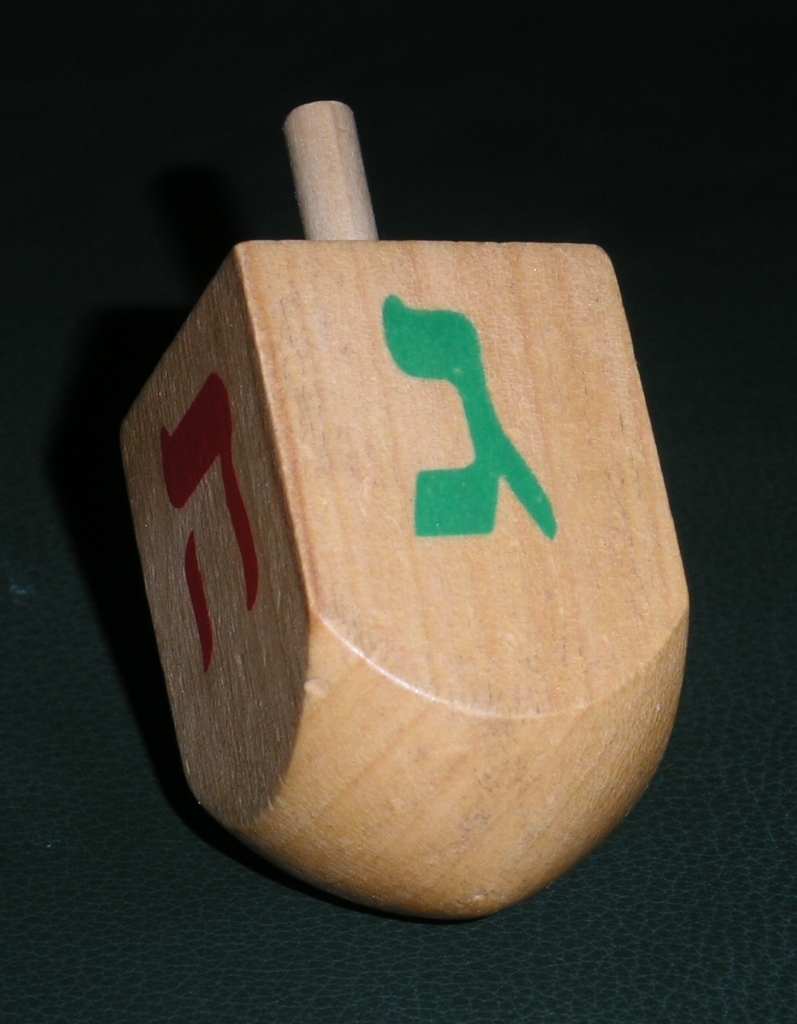
However, it should be noted that the world “dreidel” isn’t Hebrew, it’s Yiddish. The Hebrew word for dreidel is “Sivivon”, which just means “Spinning Thing”.
The first word “Nes” means “Miracle” and it is represented by the letter Nun.

The next word “Gadol” means “Great” or “Big”, represented by the letter Gimel. Notice that in Hebrew the adjective comes after the noun it is describing. We say “Great Miracle” by literally saying “Miracle Great”.

The next word “Haya” is translated as “Happened” but it really just means “Was”. This is represented by the letter “Hay”.

Finally, there is the word “Sham” meaning “There”. This refers to the city of Jerusalem where the Temple used to stand. Today, all that remains of the Temple is the Western Wall and a portion of the Northern Wall around the Temple Mount. The word “Sham” is represented by the letter “Shin”.

But if you are in Jerusalem the phrase and the letters on the dreidel are different. Instead of “Sham” they use the word “Po” meaning “Here”. Many students of Hebrew learn this word on their first day during roll call. The teacher calls a student’s name and if he or she is present, the student uses the phrase “Ani po”, meaning “I am here”. The word “Po” is represented by the letter Peh.

I hope everyone continues to have a Happy Chanukah. See you Friday.
No Comments »
On the 25th day of the Hebrew calender month of Kislev, it has been the tradition for several thousand years to celebrate a holiday called Chanukah. This festival commemorates the liberation of what would become Israel from the occupation of Seleucid forces under King Antiochus IV. Many people grow up with the fable about the oil in the Temple lamps during the rededication of the Temple after the war. Legend says that one day’s worth of oil miraculously lasted eight days, but it is false to say that the holiday is meant to celebrate this supposed miracle. Jews today recognize that story as being a metaphor for hope and perseverance in difficult times. So, if Chanukah isn’t about the miracle, why do we celebrate it?
The real essence of Chanukah is the lesson of holding to one’s beliefs regardless of external pressures. Many times throughout history, Jews have been persecuted for their culture and their faith. More than once, we have been pressed to convert to other religions. One such event was the occupation of the Levant region by Antiochus IV and his armies, who mandated the conversation of all those living in Judea to Hellenistic Greek traditions. So, who is Antiochus?
When Alexander the Great died in 323 BCE, he left a massive empire. Having spent most of his life pursuing war, Alexander’s closest political allies were his generals. When the time came to hand power to another, Alexander’s son had yet to be born. Alexander’s generals, known in this period as the Diadochi, spent many years afterward vying for control over the fragments of the Macedonian Empire. During a long period of in-fighting that involved murders both on and off the battlefield, the line of Antiochus took segments of Asia. Due to the endless wars between competing Greek forces, many local cultures grew strong enough to pursue independence, among them were Carthage, Rome and an upstart group of rebels in Judea under a devout leader named Judah Maccabee, whose name translates as “Hammer”.
The Maccabee rebels represented a fairly small portion of the Judean people. They were, in a sense, political and religious extremists intent on maintaining the traditions associated with the Temple of Jerusalem. Using guerrilla tactics to wear down the Seleucid armies (which were already stretched thin from other, larger wars), the Maccabee movement wrested control of the region from the Greeks. After the war, they rededicated the Temple, which is where the festival gets its name. “Chanukah” relates to the root word “Chanakh” meaning “To dedicate” in the sense of religious sanctification.
Since that time, the liberation of Judea has been celebrated by Jews all over the world. Because the lighting of special candelabra called Menorah (pl. Minorot) was a feature of the rededication of the Temple, the most important Chanukah tradition is the lighting of the Chanukiah, a special 9-branched Menorah. The ninth branch, called the Shamash (protector) represents God, while the other eight branches represent the eight days of the festival. Eight is a very important number in Judaism, but that’s another lesson.
Chanukah 2008 runs from the evening of Sunday, December 21st to the following Sunday, December 28th. Happy Holidays. Join us here at Judeo Talk this Wednesday for a special Chanukah edition of our Hebrew lesson.
No Comments »
|