Archive for the “Hebrew” Category
Several times now, I have made reference to the difficulty of directly translating Hebrew into English. This problem has resulted in centuries of debate over the exact meaning of many passages from the Torah. This is not an issue confined to any one religion. Modern Jews who have little to no training in Hebrew, Toritic or otherwise, often approach scripture from the same angle as Christians who only have the Old Testament in their regional vulgate. So, why is Hebrew difficult to translate and why are there so many discrepancies between the many versions of the same passages?
The story begins in Alexandria, Egypt circa 300 BCE. At this time, the conquests of Alexander the Great of Macedon spread throughout the Mediterranean region, including the former Egyptian Empire. After Alexander’s death, Egypt came under the control the Ptolemy line, maintaining a decidedly Greek influence in the area, including the Greek language. Alexandria was the home to The Great Library, a collection of texts that was, at the time, unrivaled the world over. Countless scrolls and other documents came through Alexandria where they routinely underwent translation by a veritable army of scholars.
Among those scholars were Jewish thinkers who found that it was necessary to bring their holy texts into the modern world so those Jews under Greek rule who had no Hebrew education could still study the Torah. So, the Septuagint project was born.
As the name suggests, the Septuagint was reportedly translated by a series of approximately 70 scholars. This process took place over the course of 200 years. Given the timeframe, complexity and sheer scale of the project, mistranslations and general disagreements were bound to happen.
On top of these problems, there is an issue inherent to bringing a semi-linear Semitic language into a decidedly linear European language. As I’ve pointed out before, Hebrew’s shoresh system using “root” combinations of three consonants creates the potential for myriad connotations and shared symbols between several words that aren’t necessarily related in other languages. Take for instance the Hebrew word Dahm. This means “Blood” and naturally shares a root with word Adom, the word for the color Red. Of course, these also share their root with the word Adama, “earth, ground, or soil” which is where the name Adam comes from because in Genesis Adam was created from clay. These shared roots and connotations do not survive into the Greek, let alone into further translations from Greek into other languages.
Beyond the Septuagint, the Torah or Old Testament underwent more translations into other European languages. The Greek Bible soon found its way into a Latin translation during the Roman Empire. After that, the Latin was used to translate the text into German. In time, every society with a monotheistic presence had a version of the Bible in their native tongue. As one might guess, this resulted in a very complicated version of the Telephone Game. A translation of a translation of a translation is bound to have some errors and lost content.
This doesn’t mean that it is impossible to get a lot of wisdom out of Biblical texts in a language outside of Hebrew. The stories are simple enough on the surface to be accessible in Martian if need be. All the same, Hebrew is the original language of the Torah. In order to understand the text in all its fullness, one must be able to read it as it was first written.
No Comments »

There is perhaps no city on Earth more mythic in emotional scale or more torn by conflict than Jerusalem. It is one of the oldest cities in the world, having been dated to as early as 4000 BCE. Next to Byblos in Lebanon, Jerusalem may be the oldest continually inhabited city in human history. It has been destroyed twice, once by the Babylonian Empire and then by the Roman Empire. It has been under seige, captured, recaptured and otherwise fought over hundreds of times. This makes the origin of its name tragically ironic.
At the root of Jerusalem’s Hebrew name, Yerushalayim, are three letters. They are Shin, Lamed and Mem. In all semitic languages, that root pattern and its cousins have the same connotation. Shalom, Salaam, peace.
There are many early references to the city of Jerusalem. Biblically, the first mention of it is in the book of Genesis, chapter 33. As part of his travels, the patriarch Jacob journeys to a country called Shachem, specifically to a city called Shalem. This word, Shalem, essentially means “completeness” or “wholeness”. As is often the case, specific locations in the Torah are used to represent philosophical concepts. If a troubled biblical figure travels to a city called “wholeness” there is some sort of lesson to be learned. From this and from other references, it’s fairly obvious that the people of the ancient world saw some great importance in the city that would be Jerusalem. Exactly why, it is impossible to say.
It was not just early monotheistic societies who saw greatness in Jerusalem. Egyptian records, specifically the famed Amarna Letters, mention a city in the levant using the Akkadian term Uru Uru Salam Ki. That “salam” ought to be familiar by now. As for “Uru Uru”, this shares an etymological root with a modern Hebrew word, Ir, meaning “city”. This is where the “Jeru” in Jerusalem comes from. In ancient semitic languages, repetition was used as a means of emphasis or aggrandizement. The “ki” was just a grammatical structure declaring the end of the phrase. In this case, the phrase would mean “That great city of peace”.
As Jerusalem grew and the language spoken in it solidified, the name transformed into its modern state. The current suffix “ayim” is an ancient Hebrew grammatical structure to denote duality. This makes reference to the fact that Jerusalem is built upon two hills. There is another frequent geographic term in Hebrew that uses the dual suffix. Mitzrayyim is the Hebrew word for Egypt. At the time when the Hebrew people interacted with Egypt, it was split into two kingdoms.
Many cultures have recognized Jerusalem as an important city and have used it as a symbol of peace and righteousness. The early American settlers of the Puritan pilgrim lines were especially fond of the concept of “the city on the hill”. American cities like Salem, Massachusetts bear the same etymological root as the holy city. Only time will tell whether Jerusalem will remain such a pervasive symbol in human culture. Should our species ever colonize lands beyond our own planet, I wouldn’t be surprised to hear of a settlement called Jerusalem.
No Comments »
If there is one word that sums up the core of Jewish philosophy, it is Mitzvah. This is one of those very complex Hebrew words that just doesn’t have an easy, direct translation into English, or any other language for that matter. In fact, the word Mitzvah is at the center of one of the most hotly contested mistranslations in all of monotheism: Commandment.
The first use of the word Mitzvah comes in the biblical book of Exodus. After the Israelites leave Egypt, God leads them to Mt. Sinai (or Mt. Horeb, depending on who you talk to) and gives them the Ten…
Commandments? Not exactly. The word in the Torah is Mitzvot, the plural of Mitzvah. That word doesn’t even share a common root with the two different words in Hebrew that can mean “Command”. One of those words is the verb L’shalot which basically just means, “To tell someone to do something” and the other is a verb from a different “family” of verbs, Pikodah. Neither of these could possibly be construed to relate to Mitzvah.
So, why translate Mitzvah as “Commandment”? Well, that’s an issue of philosophy. The list of Mitzvot handed down at Sinai have commonly been interpreted as laws that come directly from God. Philosophically, it sets more nicely for a lot of believers and theologians to think of them as hard rules given by the ultimate authority. It’s certainly easier to explain them that way.
The truth is that the Ten Mitzvot aren’t commandments in any form, not even grammatically. Take for instance the Mitzvah commonly translated as, “Thou shalt not kill”. In the original Hebrew, the phrase is Loh Tirtzakh. This literally means “No murder.” Were this a command, it would be phrased Tzakh Loh. Is this just nit-picking? Absolutely not. There is a very different connotation here.
Philosophically and linguistically speaking, that big list of ten things just doesn’t make sense as an authoritative command. The Torah explicitly states that human beings have free will. It seems a lot more likely, given context, that the big list actually means to say, “In a society of righteous people, the following things are true.” The Ten Mitzvot are not followed by The Ten Consequences for Breaking The Ten Mitzvot. These aren’t rules or commands, they’re statements of righteousness.
So, what exactly does Mitzvah mean? These days, Jews use the term to mean any act of goodness or kindness. While that’s closer to the spirit of the word, it’s still not exactly right. It’s true that all good and kind acts are Mitzvot, but not all Mitzvot are good or kind. More accurately, Mitzvah is a lifestyle. It means remaining mindful of what would be best in any situation. To live a life of Mitzvah is to strive to make the world better through actions and to appreciate what good there is in the world already. There are as many Mitzvot as there are experiences in life. Every experience is an opportunity for Mitzvah, even times of difficulty and sadness. It is sad to lose a loved one, but it is a Mitzvah to fondly remember the dead. It is frustrating to meet with cruelty and ignorance, but it is a Mitzvah to refrain from anger and choose to educate the ignorant.
This lesson is just the beginning of understanding Mitzvah. It is a very rich, complex philosophy and it is the central preoccupation of Jewish theology. In a sense, it is a word that has no translation because its meaning changes with each year and each life that lives it.
No Comments »
Last week’s Hebrew lesson began our look into the history of the language and the people who spoke it. Today, we’ll be exploring where the term “Hebrew” itself originates.
When discussing the term “Hebrew” in reference to the language, there are actually three separate words we need to understand: Hebrew, Yihudit, and Ivrit.
We’ll begin with “Yihudit” because the other two terms are much more closely related. “Yihudit” is a word that means, “The language of Yihudah”, while the term “Yihudah” refers to the kingdom of Judah. In the ancient territory that we know today as the modern State of Israel, there were actually two presiding kingdoms. In the north was the ancient kingdom of Israel, which had the kingdom of Judah at its southern border. When the Roman Empire came to dominate the region, they latinized the name of the territory into Judea. This is where the terms “Judaism” and “Jewish” come from. The people who lived in Judah would have said they spoke “Yihudit”, as naming languages based on the regions in which they were spoken was the linguistic convention of ancient Hebrew speakers.
The terms “Ivrit” and “Hebrew” are related both linguistically and in spirit. “Ivrit” comes from the root word “Avar” which refers to someone who comes from far away. It should be noted that this is distinct from the words referring specifically to foreigners. The Hebrew word “Goi’im” is the most direct translation of “foreign people” and became the modern Yiddish term “Goyim” which refers to all non-Jewish people. In addition, there was an ancient Canaanite slang term for foreigners, “Gidolim” which literally translates as “Big ones”. This is where the story of David and Goliath comes from. Goliath originally wasn’t a giant, but a foreign leader.
The “far away” to which “Avar” refers is actually closer in spirit of the word “Hebrew”. That word can be traced to many similar iterations in various ancient Near and Middle Eastern cultures. Many Near Eastern cultures, like Sumeria, Akkad and Babylon had the term “Ibiru”, while the Egyptians adopted the word into their Coptic language as “Ipiru”. These words essentially indicate a people who live outside the cities. They often get referenced as the people who live on the other side of the river, which had a similar connotation as the modern colloquial term “People from the wrong side of the tracks”. At the time of its regular use, “Ibiru” didn’t necessarily refer to a particular ethnic group, but to a certain variety of ancient civilization. People called “Ibiru” weren’t really seen as being foreigners because they weren’t from a particular kingdom or city-state. Many of them were nomadic and tribal. Those people who would eventually become the dominant ethnic group in Canaan were known as being “Ibiru” in the lands in which they previously dwelt.
Ultimately, this sense of the Jewish people being outsiders without necessarily being foreigners has carried throughout Jewish history. It is, for better or worse, an intrinsic part of the Jewish identity. Perhaps this is why Jews have flourished in the United States. Most of the people who came to live here were not natives of the land, so America became a place of outsiders who were all equally foreign.
No Comments »
Whenever a curious non-Jew enters a synagogue for the first time, one of the most striking parts is the strangeness of Hebrew. It is read right to left and the letters are completely foreign. It looks more than just ancient, it looks arcane. Hebrew is full of sounds not found in American English and the chanted prayers come from a very different time and place. But Hebrew really isn’t as strange, or as foreign, as it first seems. Let’s break down some bits of history to show how Hebrew really isn’t that far removed from the languages we know in the West.
Hebrew didn’t develop in isolation. In fact, it’s one of most-traveled tongues in the world. It belongs to a linguistic super-family called the Afro-Asiatic languages. The vast majority of European languages come from a super-family known as Indo-European. The Hebrew we see in the Torah is Classical Hebrew, which itself is fairly close to Modern Hebrew. To put things in historical context, 2000 years ago the version of Hebrew spoken in Judea was called Aramaic, but Classical Hebrew had already come to be adopted for ritual purposes. The two languages are very close. Aramaic was really more of an everyday spoken language.
Long before even Classical Hebrew when the Jewish culture was in its early stages of development, those people who would become the Hebrews likely wrote and spoke Proto-Canaanite, the language of the loose amalgamation of peoples in the region of Canaan near the dawn of human civilization. Proto-Canaanite was a pictograph system, meaning that the symbols that later became associated with specific sounds began representing whole concepts. For example, the original pictograph for the letter Alef resembles the head of a bull and was meant to indicate strength or leadership.

From Proto-Canaanite, a more directly phonetic alphabet developed in the Phoenecian language. The region of Phoenecia was, like many parts of the world at that time, arranged as a series of independent city-states rather than a unified kingdom. To run with our example, the letter Alef transformed into the following shape:

It’s easy to see how this letter, like so much of the Phoenician alphabet, influenced the Greek language, which is the origin of the letter Alpha, itself being functionally identical to the modern letter A. This is because Greek informed Etruscan and Etruscan developed into Latin. Today, we anglophones use the Roman Latin Alphabet.
Even the term “Alphabet” comes from the first two letters in that system stemming from Proto-Canaanite, “Alef” and “Bet”. Even the progression of Western letters follows the the same progression as Hebrew. Where the Greek runs- Alpha, Beta, Gamma, Delta, etc., Hebrew runs- Alef, Bet, Gimel, Dalet, etc.
This is how languages develop; not in a vacuum, but as a confluence of cross-cultural communication. There are even a few Hebrew words that snuck their way into English. One that comes to mind is the word Sabbatical, meaning an extended period of vacation from one’s work. This comes from the Hebrew term “Shabbat”, which means Sabbath, and comes from the Hebrew verb Lishavet meaning “To rest”.
So, no matter how strange and foreign Hebrew may seem to a lifelong English-speaker, the two languages share a common history, as do the majority of the languages spoken on planet Earth today.
1 Comment »
Shalom, everyone. I wish I could write this post in a less tragic time, but I also won’t avoid the topic of the recent conflict in Gaza. It’s difficult to watch and read the reports coming out of the region, not just as a Jew but as a human being. Regardless of one’s affiliations, violence on such a scale is heartbreaking. Moreover, it is impossible for any truly spiritual person to justify. As it has been, seemingly since the beginning of human civilzation, the agenda of a radical few has resulted in the pain and loss of many peaceful people. While I strive to be a supporter of Israel, I cannot condone the scale of the Israeli military’s response to the rocket attacks from Gaza. Of course, we also shouldn’t ignore the intent of those rocket attacks. It is short-sighted and inhumane to approach this conflict or the many like it in the past with a binary attitude. How anyone can call one side of this war the “right” side and still call themselves a good Jew, or a good Muslim, is beyond me.
Because of this conflict, today’s Hebrew lesson will center around a prayer called Oseh Shalom, which literally means, “Make Peace”. The prayer actually appears at the end of the Kaddish, the prayer for remembering lost loved ones. The text, with transliteration, is as follows:
The usual translation of Oseh Shalom is, “He who makes peace in Heaven will make peace for us throughout Israel, and we say Amen”.
But this translation is neither direct nor in the full spirit of Jewish philosophy. According to Jewish law and practice, it is the task of living people to make peace on Earth, not by a magical blessing from God. This philosophy is known as Tikun Olam, literally “The repair of everything”. Tikun Olam is the task of every living person, Jew and gentile.
Moreover, the standard translation of Oseh Shalom takes some liberties with the phrasing. I would like to suggest an alternative translation with a different, more direct connotation.
Oseh shalom b’imromav “Make peace your greatest example (lit. in the highest place)
Hu ya’aseh shalom aleinu “He who will make peace for us all”
V’al kol Yisrael “And in all of Israel”
V’imru amen “We agree”
My suggested translation places the focus of the prayer on the actions of individuals, rather than on a entreating God for help. The line “He who will make peace for us all” can certainly refer to God, but it doesn’t have to. It can simply mean, “You individual person who strives to make peace for everyone”. The term b’imromav doesn’t actually refer to Heaven, the Hebrew for which is Shamayim. Rather, the term simply means “in a high place” or possibly “in the highest place”. This can very easily mean that peace should be made the greatest public example. As the prayer in my translation says, the Jewish people, Israel, can only support the actions of individuals pursuing peace. If you support violence and conflict, you stray from the core of the Jewish faith.
No Comments »
Last night, the festival of Chanukah came to a close. In its way, Chanukah is unique among Jewish holidays. While many of the faith’s observances last for several nights, none but Chanukah have an active ritual repeated on each of the nights. For those who diligently keep the customs of Chanukah this means lighting the Menorah eight times, a powerful sensory ritual. The sight of the flames, the smell of the smoke, even the motion of guiding the Shamas to each branch can evoke memories of childhood and of other Chanukahs past. We do these rituals not just because they are customs but because physical acts require enough concentration to focus us on the prayers and the feelings associated with the holiday.
So, when we repeat the same prayers for eight successive nights, lent focus by the act of lighting the Menorah, it is natural for us to question what those prayers actually mean. We are a people who often pray in an ancient language that most of us can’t speak. We frequently don’t even know the literal translations, let alone the layers of meaning underneath.
On Chanukah we say two prayers every time we light the Menorah and a third prayer on the first night only. On the first night, in addition to the two others, we say the Shehechianu, a prayer said at all occasions of firsts or of new things. The other two prayers are:
 Blessed are you, Adonai our God, King of the Universe Blessed are you, Adonai our God, King of the Universe
 Who makes us holy with the Mitzvah we do Who makes us holy with the Mitzvah we do
 When we light the lights of Chanukah (amen) When we light the lights of Chanukah (amen)
And
Blessed are you, Adonai our God, King of the Universe
 Who did miracles for our fathers on this day at this time (amen) Who did miracles for our fathers on this day at this time (amen)
So, why are our prayers structured like this? Why do almost all Jewish prayers begin with the same line? Is there a purpose to the repetition of placing all the honor on God?
There are several layers of answers to these questions. First, the structure of Hebrew prayers is essentially standardized. It is a result of the Rabbinic Age in which we live. When Jerusalem was sacked by the Roman Empire the Temple was destroyed and the Jews were forced to scatter across the world. In order for the Jewish faith to survive and Jews to stay connected to one another regardless of where they lived, the prayers of our ancient heritage were standardized.
As for why the majority of Hebrew prayers open with the same line, it is part of one of the faith’s central tenets. In the Torah and in all liturgy afterward, Judaism has attempted to avoid placing too much honor or power on individual people. The responsibility and the glory almost always goes either to God or to the entire community as a whole. When we light the Chanukah candles, we do not honor Judah Maccabee or any other individual because the holiday isn’t supposed to be a time of ancestor worship. By placing the honor on God we allow hope and power to exist in the present day and out of the hands of anyone who could possibly be corrupted by such power.
We also place so much focus on community not just to keep others from becoming arrogant, but also to keep us focused on what really matters. These holidays are nothing if we don’t share them with others because these holidays don’t exist in a vacuum, cut off from the rest of our lives. However ornate or archaic the wording, these two prayers above say simple things. They can be easily translated into more concise language. “It is a good and happy thing to light Chanukah candles” and “A wonderful thing happened a long time ago. We’re so happy we can celebrate it together today.”
In order to make an ancient religion relevant to our modern lives, we must come to a colloquial understanding of what our prayers mean. By keeping the text of those prayers the same across the ages, we allow each generation to come to its own understanding of their meaning. It is a Mitzvah, a good and holy thing, to contemplate prayers and what they mean. If it sounds old, stuffy or irrelevant, chances are you just aren’t modernizing your interpretation.
No Comments »
Shalom, everyone and Chag Chanukah Sameyach! Welcome to Wednesday Hebrew at Judeo Talk. Today’s lesson is going to revolve around terms and phrases relating to the holiday of Chanukah. Tonight is the fourth night of the Festival of Lights. Word has it there’s this other holiday happening sometime soon, though I can’t seem to recall the name…
Let’s jump into the first part of the lesson. In my greeting, I used the phrase “Chag Chanukah Sameyach” which translates as “Happy Chanukah Holiday”.
חג
The word “Chag” (seen above) means “Holiday”. It is a shortening of an older, now mostly unused word, חגג “Chagag”. “Chagag” is an ancient word denoting a pilgrimage to the Temple of Jerusalem or even the celebration of that pilgrimage. In Arabic, there is a cognate of this word that is still used today. It is “Hajj” (حج), the pilgrimage to Mecca that all Muslims are very strongly encouraged to experience at least once in their lives. After the destruction of the Second Temple of Jerusalem by the Roman Empire 2000 years ago, Jews no longer had any place to perform their rituals. This ended the Jewish practice of animal sacrifice and formally began the Rabbinic age in which we still live. Today, there is some debate about whether or not we should call “Chanukah” a “Chag” because in more conservative traditions, the term is reserved for Holy Days mentioned specifically in the Torah.
The other part of the phrase “Chag Chanukah Sameyach” is the word that means “Happy”.
“Sameyach” is one of several Hebrew words that means “Happy”. The many ways to say “Happy” in Hebrew each mean something more specific than the general term of the translation. The word “Sameyach” refers to a giddy, celebratory happiness. A Hebrew teacher of mine in college described “Sameyach” by waving her hands in the air and saying “Yay!” In the holiday greeting phrase, the connotation is that the speaker wishes the listener a carefree celebration and true jubilation.
The other Hebrew phrase we’re going to learn today is “Nes Gadol Haya Sham”, meaning “A Great Miracle Happened There”. This phrase refers to the liberation of Judea I described in my last update. The first letter of each word in this phrase can be found on the four faces of the dreidel.
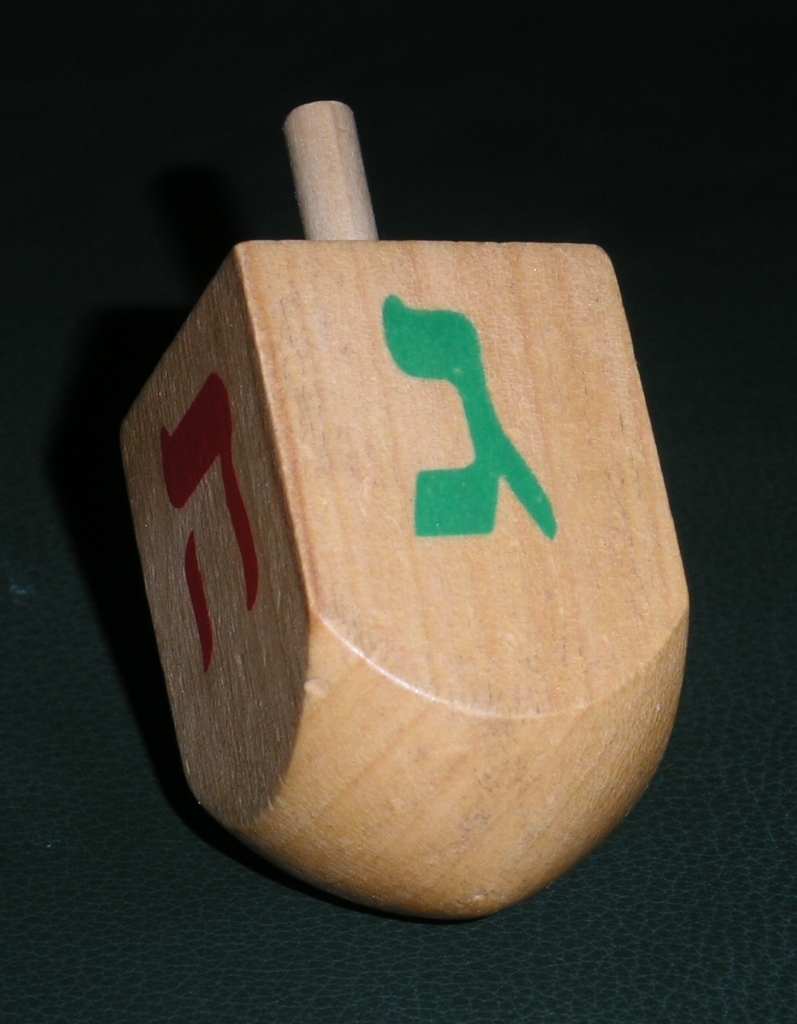
However, it should be noted that the world “dreidel” isn’t Hebrew, it’s Yiddish. The Hebrew word for dreidel is “Sivivon”, which just means “Spinning Thing”.
The first word “Nes” means “Miracle” and it is represented by the letter Nun.

The next word “Gadol” means “Great” or “Big”, represented by the letter Gimel. Notice that in Hebrew the adjective comes after the noun it is describing. We say “Great Miracle” by literally saying “Miracle Great”.

The next word “Haya” is translated as “Happened” but it really just means “Was”. This is represented by the letter “Hay”.

Finally, there is the word “Sham” meaning “There”. This refers to the city of Jerusalem where the Temple used to stand. Today, all that remains of the Temple is the Western Wall and a portion of the Northern Wall around the Temple Mount. The word “Sham” is represented by the letter “Shin”.

But if you are in Jerusalem the phrase and the letters on the dreidel are different. Instead of “Sham” they use the word “Po” meaning “Here”. Many students of Hebrew learn this word on their first day during roll call. The teacher calls a student’s name and if he or she is present, the student uses the phrase “Ani po”, meaning “I am here”. The word “Po” is represented by the letter Peh.

I hope everyone continues to have a Happy Chanukah. See you Friday.
No Comments »
Shalom, friends. It’s Wednesday at Judeo Talk and that means it’s time for our weekly Hebrew lesson. Every week we will be discussing a different Hebrew letter, word or phrase and its importance to Jewish faith and culture.
This being our first installment of Wednesday Hebrew, we’re already on the subject of beginnings. So, I thought I’d take the opportunity to give a quick lesson about one of the most famous phrases in the Torah.
The word Bereishit (Beh-ray-sheet), which means “In the beginning”.
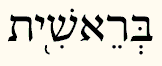
This is the first word in the Hebrew bible, known colloquially as The Old Testament. Hebrew is a very deep, complex language that is often used in the Torah in such a way that single words, even individual letters have multiple layers of meaning. The fact that Bereishit is the first word in the Torah, and more precisely that the letter Bet is the first letter in the Torah, is itself a lesson and an object of focus for the rest of the Hebrew bible.
The Hebrew letter Bet makes the same sound as the English letter B. In the word “Bereishit” the Bet acts as the common suffix “Bih” meaning “In”. The word “Reishit” meaning “Beginning” comes from the term “Rishon” which means “First”. In fact, the word “Rishon” plays an important part in the Book of Genesis. “Rishon” is visually and phonetically very distinct from the more common root for the number 1, which is “Echad”. Linguistic focus points like this appear throughout the Torah and are meant to give us pause and to indicate something special. Using the term “Rishon” and its derivatives makes this portion of the Torah focus on beginnings, on firsts and most importantly on uniqueness.

There is also a Midrash associated with Bet and the importance of its placement at the very beginning of the Torah. Young Jews are asked to imagine themselves as the dot in the middle of Bet. Notice how the only clear path is directly forward (Hebrew is read from right to left). If the Torah begins with Bet and we live our lives by the Torah, then we must remember to keep our minds on the present and on the potential of the future. We must not dwell on the past, which is irretrievably behind us. We must not gaze at our feet in inaction or preoccupy ourselves with the grave above which we walk. And however pious we may be we must not look upward to Heaven, either for guidance or in aspirations toward paradise, while there is so much for us to do here in life.
So, from the very beginning (literally), the Torah establishes itself as document concerned with life. As we continue with our lessons, we will see this sentiment reiterated time and again. This is the true depth and power of Torah study. In every letter there is a lesson. The stories themselves are important, but how they are told can have just as much, or sometimes more, meaning.
No Comments »
|