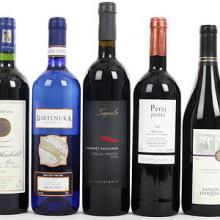
Many Americans, both Jewish and non-Jewish, have grown up with an understanding of kosher wine. Specifically, most know of the sweet, low-alcohol varieties made from concord grapes, namely Manischewitz and Mogen David. But what exactly separates kosher wine from non-kosher wine? And just as importantly, are those things relevant to modern Jews?
There are a lot of details that go into what exactly makes wine kosher, but most of it has to do with issues much larger than wine production itself. On the surface, the only real concern for modern Jews who keep kosher is what fining agents are used in a wine's production. In wine crafting, the process of fining is the use of certain organic processes to eliminate impurities in the wine that can't be mechanically filtered out. Many organic fining agents are strictly non-kosher, while others can contribute to making a meal non-kosher. Strictly forbidden fining agents like powders made from animal blood are essentially never used in the modern day, but products derived from dairy still are. Since it is against kashrut to mix meat and dairy, this can result in an inadvertently non-kosher meal.
But the concept goes deeper than that and has a lot more history to it. Classically, the most significant point of concern in kosher wine production is the assurance that every step in the process, from grape growing to fermentation, sale and handling of bottles, is in the hands of observant Jews. This more or less guarantees that the agriculture of the grapes is kosher (a much more involved concept) and that the final product has not been tampered with.
In the case of the latter, safe food was a major concern for Jews in the pre-modern world. Even into the 1700's and beyond, Jews were regularly accused of poisoning non-Jewish food and water sources. Tight control of something like ritual wine wasn't just a matter of religion, but a matter of community security against reprisal for a perceived poisoning attack.
When it comes to the agriculture surrounding wine production, there are a whole host of laws and Talmudic rulings concerning agriculture and business. There is most definitely a difference, especially in antiquity, between a kosher and non-kosher farm. This relates to everything from how the farmer treats the soil, to how the farmer treats animals and workers on the farm. The laws of kashrut mean to avoid indirectly supporting unethical farming and business practices, thus the insistence of using only products from respected, observant Jews according to the rulings of Jewish judges. In times of polytheistic dominance, there was also some concern about Jews interacting with idol-worshipping cultures who also employed wine as a holy libation.
As is the case with a lot of long-standing matters of traditional law, there is a divide in modern society between different sects of Judaism. Orthodox communities still hold to the letter of the law concerning wine, while Conservative groups are a bit more lenient depending on certain discussions that took place among respected rabbis in the 1960's and 1970's in regard to the automation of wine production in the United States. For Reform and other progressive Jewish communities, all wine produced using modern standards of cultivation and craft are acceptable for ritual purposes, as most progressive Jewish communities either keep no kosher laws or are fairly lenient about them.
As for those classic concord varieties, those are merely the most common kinds of kosher wine in America. They are by no means the only kinds available. Many companies have filled the market with higher quality kosher wine, especially vineyards based out of Israel. Kosher wine does not need to be synonymous with sickly-sweet wine made from, let's face it, the wrong kind of grape.